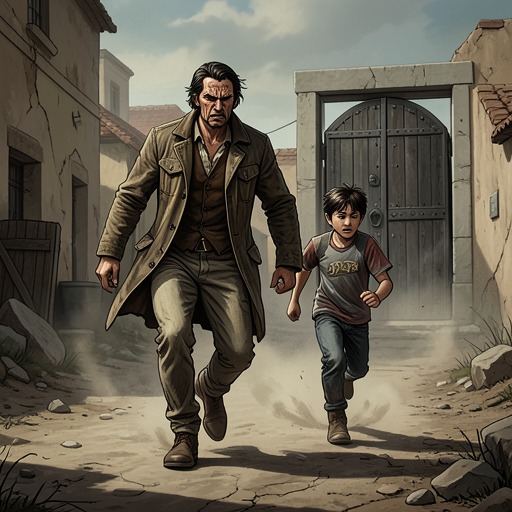
Viola and Aaron: relentless pursuit and escape
The Knife of Never Letting GoViola and Aaron: relentless pursuit and escape is a relationship formed under immediate threat, with Aaron pursuing Viola as a potential sacrifice and Viola resisting him even when she cannot speak. Their early encounter establishes its defining imbalance: Aaron controls the situation by force, while Viola’s silence makes her difficult to hear but does not make her passive. Her eventual escape, still restrained, leaves the conflict unresolved and exposes the danger in Aaron’s conviction that another person can be made into an offering.
An encounter shaped by pursuit
When Aaron suddenly appears, Todd is trying to get the frightened Viola to her feet and urge her onward. Aaron’s arrival turns an attempt at escape into a chase. He looks around in a sudden panic for a sign, then reacts to the sound of Viola running and pursues her without another look at Todd. The shift is abrupt: Todd’s attention had been on getting Viola away, but Aaron’s pursuit makes her the immediate focus of the danger.
The scene presents their relationship through movement rather than conversation. Viola runs; Aaron follows; Todd and Manchee try to keep up. Because Viola makes no sound that Todd can use to track her in the usual way, her silence becomes a distinctive counterpoint to Aaron’s conspicuous Noise. Yet it does not shield her: Todd hears her scream and follows the trail left by Aaron as he pushes through the surrounding brush. The contrast makes Viola’s silence both a practical difficulty for her would-be rescuer and a recurring sign of her difference from the men around her.
Capture and intended sacrifice
Todd catches up to them at shallow water, where Aaron has cornered Viola against a tree and is holding her wrists. She is struggling to get free, but Todd arrives without a clear plan for how to stop Aaron. The scene leaves the immediate balance of power with Aaron; Viola’s resistance is visible, but she remains physically restrained and in danger.
The narration identifies the purpose of Aaron’s treatment of her as sacrifice. That framing changes the meaning of the pursuit: he is not simply trying to overtake a fleeing person, but treating Viola as someone whose life can serve an end he has chosen. The evidence does not explain the full rationale for selecting her in this moment, so the relationship is clearest in the unequal roles the scene assigns them: Aaron pursues and confines; Viola refuses to cooperate and tries to escape.
Escape without reconciliation
Later, Todd and Aaron are down when the silence draws their attention upward and they see Viola standing over them, still restrained. Her escape from Aaron’s immediate control is therefore real but incomplete: the cord remains around her wrists. Todd takes the knife from her hand and uses it to cut the binding. Viola rubs her wrists and continues to stare at him without speaking.
This reversal does not establish any reconciliation between Viola and Aaron. Instead, it separates escape from safety: Viola has got free of his control for the moment, but the restraint she still bears makes the cost of his pursuit visible. Nor does silence mean consent or helplessness. Her running, fighting, and subsequent presence over the two men show action without spoken explanation; the narrative records her choices through what she does rather than supplying dialogue she never gives.
The ideology behind the threat
The account of New World’s history supplies a wider context for Aaron’s treatment of Viola. Ben describes years of hardship, including failed crops and sickness, followed by preaching that blamed the Spackle. That accusation grew into a movement and then a war in which the human side had guns and the Spackle did not. The account presents collective violence as something made possible by turning hardship into blame directed at an already vulnerable group.
Ben also links Aaron and Mayor Prentiss to the later violence in Prentisstown. He says that Aaron preached that what was hidden must be evil, and that many men were swayed by this preaching and the Mayor’s influence. Women and the men who tried to protect them were killed. This history does not make the scene with Viola identical to those earlier acts, but it places Aaron’s intended sacrifice within a broader pattern: his beliefs give violence against others a moral justification. Viola’s refusal to submit thus challenges not only his immediate control over her but also the logic that marks a person as a legitimate victim.
Significance of the relationship
The relationship’s defining contrast is between Aaron’s attempt to impose a meaning on Viola and her continued capacity to act against it. He pursues her, restrains her, and treats her as an offering; she runs, struggles, and eventually stands free of his immediate grasp. Her silence sharpens that contrast because it prevents the relationship from becoming a contest of competing speeches. Its stakes are instead carried by pursuit, restraint, escape, and the cut cord.
The episode also distinguishes rescue from possession. Todd is unable to intervene decisively when he first reaches them, and Viola’s appearance afterward shows that she has escaped Aaron’s immediate control before Todd cuts her restraints. The evidence therefore gives her own resistance a central place in the outcome. Aaron’s authority over her is forceful but not complete, and the scene ends not with an explanation from either character but with Viola still silent, looking at Todd after the binding has been removed.